Acorn Universal Networking
Econet lets BBC and Archimedes computers share disc drives and printers, and also supported applications such as terminals, databases, and games. As applications and files grew, Econet’s roughly 200 kbit/s speed became a limitation.
In 1992, Acorn announced Acorn Universal Networking (AUN) as a way to add faster technologies such as Ethernet while retaining existing Econet equipment and software.[1]
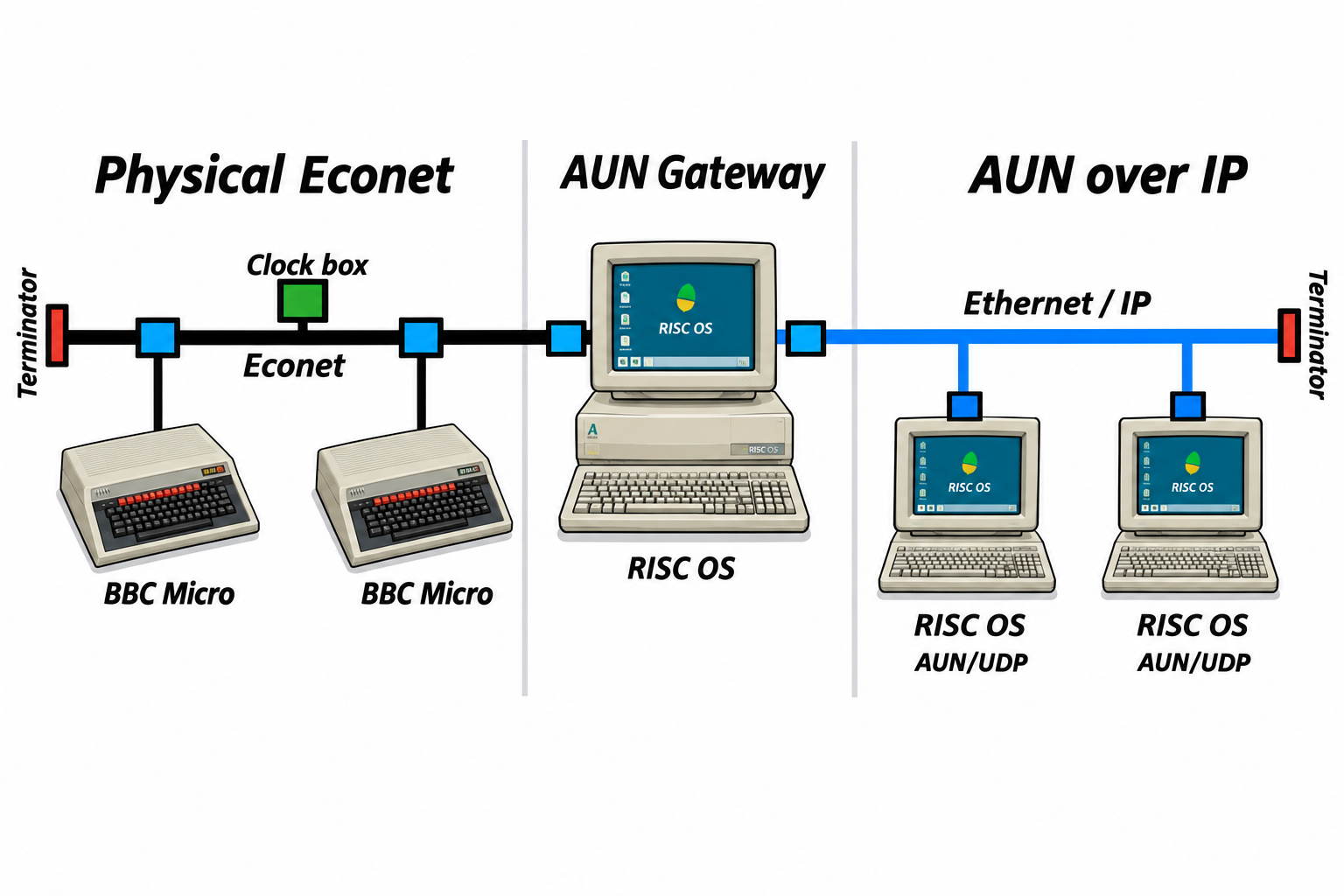
Econet cable and (coaxial 10BASE2) Ethernet remained separate physical networks, connected by RISC OS gateway computers running AUN software. Ethernet could provide a faster (10 Mbit/s) backbone, while Econet machines continued to use their existing network services.[1][2]
Econet over IP
With AUN software, Econet applications can communicate over UDP/IP (port 32768). AUN packets are encapsulated in UDP datagrams. An AUN packet starts with an 8-byte header followed by optional data:[3]
| Bytes | Field | Purpose |
|---|---|---|
| 0 | AUN packet type | Data, broadcast, acknowledgement, rejection, or Immediate/reply |
| 1 | Econet port | Identifies the Econet service; distinct from the UDP port |
| 2 | Control | Econet control byte |
| 3 | Padding | Reserved, normally zero |
| 4–7 | Sequence number | 32-bit little-endian value used to match packets and responses |
| 8 onward | Data | Optional packet data |
This lets Econet software continue to address stations using Econet-style ‘network.station’ numbers. Traditional Econet uses network numbers 1–127 and station numbers 1–254; AUN/IP station networks use numbers 128–251. An AUN map associates these addresses with IP addresses. For example, mapping ‘192.168.0.x’ to AUN network 128 means ‘192.168.0.1’ is addressed as ‘128.1’.[2]
AUN provides the networking path, not the application service itself: file and printer sharing still require the appropriate Econet-compatible clients and servers.[2] In Episode 4, I will look at using PiEconetBridge as a modern gateway between a physical Econet and an AUN/IP network.
References
- Acorn, “Acorn introduces Universal Networking” (1992 press release)
- RISC OS, “An introduction to AUN”
- Pi1MHz, AUN/UDP wire-format notes
- AUN FileStore, Econet Print Server Protocol
- PiEconetBridge project
Series episodes
-
Acorn Econet episode 4: PiEconetBridge installation (2026-09-26)
-
Acorn Econet episode 3: Acorn Universal Networking (AUN) (2026-09-12)
-
Acorn Econet episode 2: technical background (2026-02-14)
-
Acorn Econet episode 1: introduction (2026-02-07)