Episode 1 introduced Acorn Econet. In this second episode, I will go into more technical detail.
Next, Episode 3 will briefly cover Acorn Universal Networking (AUN), the evolution of original Econet before episode 4 introduces the PiEconetBridge. Stay tuned ;-)
Econet physical layer
Econet is a 5-wire bus network: one wire pair for data transmission, one wire-pair for the clock signal plus a common ground. Econet networks can be split into multiple segments, each up to 500 meters long. Cables should be terminated at each end.
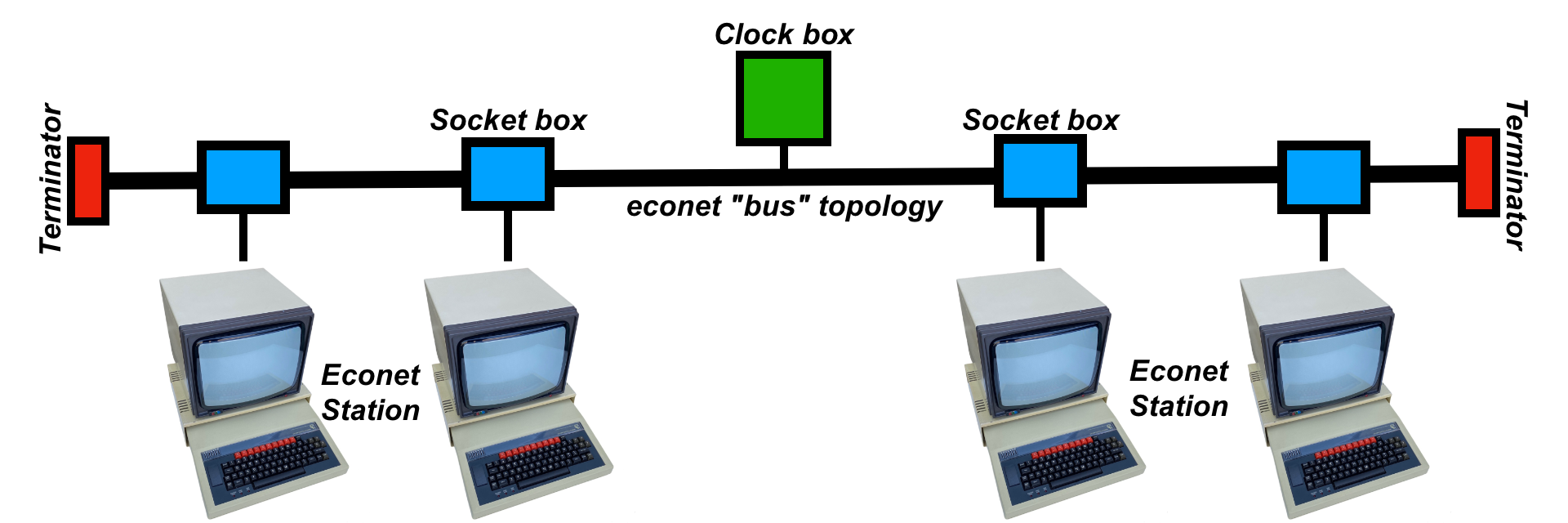
A “Clock box” is placed roughly in the middle of the bus. It generates an asymmetric clock signal (separate ‘mark’ and ‘space’ period) ranging from 167 kHz (at max. cable length of 1000m) to about 230 kHz (limited by the BBC Micro). The ‘mark’ and ‘space’ period can be adjusted, to accomodate for the type of clients connected to the Econet.
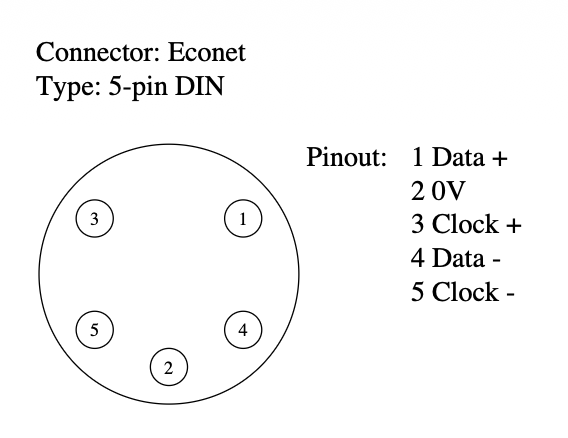
Workstations are connected to “Socket boxes” using a fairly short cable with 5-pin 180 degree DIN connectors on each end (commonly used in older stereo equipment).
 |
|---|
| Acorn Support Group Application Note 238 |
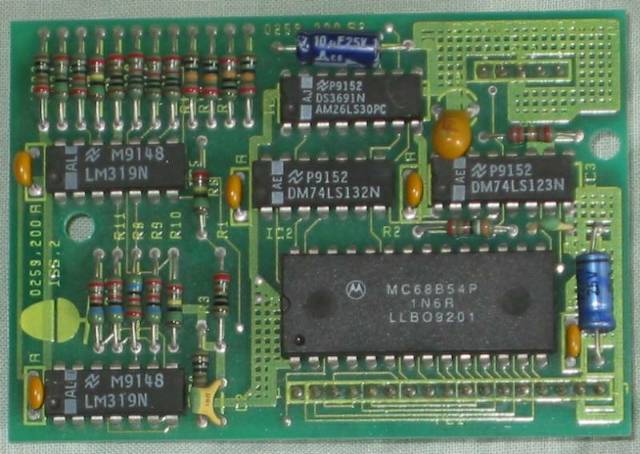
A lot of low-level functionality is provided by the 68B54 ADLC chip (“Advanced Data Link Controller”, datasheet PDF) on the Econet interface of each Station.
Acorn sold Econet upgrade kits for the BBC Micro with several ICs that needed to be soldered into the mainboard. For the BBC Master and most later models, Acorn developed the ADF10 Econet Module. This could simply be plugged into the mainboard - no more soldering needed!
 |
|---|
| Image source: https://chrisacorns.computinghistory.org.uk/8bit_Upgrades/Acorn_ADF10_EconetModule.html |
Econet cabling
I’ve personally had good experience with Roland RMIDI-B3 cables - they use the same 5-pin DIN connectors with 4 conductors plus shielding connected to pin 2 (ground).
For long distances, you may need to build your own - using shielded cable. Ensure that all 5 pins are fully wired, straight through. You can use a multimeter to verify.
Technical specification
Quoting Chris’s Acorns:
Acorn's 1980 specification for Econet was:

Up to 255 stations per Econet
Econets may be joined together by Gateways
Connection by 4-wire cable to each station (typical cost in 1980 12p per metre)
Station seperation up to 1 Kilometre
Data transfer rate up to 210 kilobaud
Differential signals for high noise-immunity and minimal radiation
Crash-detect circuitry and colision-arbitration algorithm minimise the need for retries
Econet hardware fits inside Atom case; eurocard version for Acorn System 2/3/4
Econet software in 4K ROM, fits on Atom board
Econet executed automatically on BRK
In practice, ‘210 kilobaud’ means a transfer rate of around 20 kBytes/s. In today’s terms, this is considered very slow. But back then, it was very close to the speed of a 5.25” floppy disk - the fastest medium commonly available.
Series episodes
-
Acorn Econet episode 2: technical background (2026-02-14)
-
Acorn Econet episode 1: introduction (2026-02-07)